
Table of contents
- What is keyword density?
- How do you calculate keyword density?
- Is there an ideal keyword density for SEO in 2026?
- A safe keyword density for SEO you can actually use
- Where the keyword should appear (this beats the count)
- How to check keyword density for SEO: 4 ways
- Signs your article is keyword stuffed
- How to fix an over-optimised article
- Does keyword density matter for AI Overviews and ChatGPT?
- Keyword density for SEO in Hindi and Hinglish content
- FAQ
- Check your keyword density for SEO in two minutes
Quick answer: Keyword density for SEO is how often your target phrase appears, as a percentage of the total words on the page. Google doesn't use a fixed number. A practical range is 0.5% to 1% for the exact phrase, which works out to about 8 to 15 uses in a 1,500-word article. Placement matters more than the count.
Rank Math, Yoast and most content tools still show a density score, so the question about keyword density for SEO keeps coming up: what number is safe? The plugins don't agree with each other, and Google says the number isn't what it looks at. Below you'll find what each of them actually says, a working range you can use today, four ways to check your own page, and a before-and-after fix for a stuffed paragraph.
What is keyword density?
Keyword density is the share of your words taken up by one keyword or phrase. If a 1,000-word post uses "home loan eligibility" 10 times, its density is 1%. It's a quick way to see whether a phrase is missing, about right or repeated so often that the writing sounds forced.
Back when search engines leaned heavily on matching words, people chased density to rank. Today it's a sanity check for your own writing.
How do you calculate keyword density?
Divide the number of times the keyword appears by the total word count, then multiply by 100.
Keyword density = (keyword uses ÷ total words) × 100
Three worked examples:
- A 600-word product page uses "cotton kurti set" 5 times: 5 ÷ 600 × 100 = 0.83%.
- A 1,500-word guide uses "content brief template" 12 times: 12 ÷ 1,500 × 100 = 0.8%.
- A 900-word local page uses "ac repair in karnal" 27 times: 27 ÷ 900 × 100 = 3%. That one reads as stuffed, and any reader would notice before a tool did.
Some tools use a slightly different formula for multi-word phrases. They multiply the uses by the number of words in the phrase, so a three-word keyword counts three times as heavily. That's why two tools can show different numbers for the same page. Check which method yours uses before you chase a target.
Is there an ideal keyword density for SEO in 2026?
No, not from Google. Its spam policies describe keyword stuffing as repeating words or phrases so often that it sounds unnatural, with no percentage attached. In 2023 Google's Search Liaison, Danny Sullivan, said using a term a set number of times doesn't make something stuffing and that "it doesn't really work that way" (reported by Search Engine Roundtable). His advice was to write for people.
SEO plugins do set numbers, and they disagree:
- Yoast SEO: a green light between 0.5% and 3%, per Yoast's own documentation. The free version only matches the exact keyphrase words. Synonyms and word forms need Premium.
- Rank Math: its best score sits around 1% to 1.5%, and it warns about overuse above 2.5%. It also counts plurals and variations.
- SerpNuts: keeps the focus keyword and each secondary keyword at or under 1%, and flags anything above that live while you write.
So 3% gets a green bullet in Yoast and a warning in Rank Math. Neither number comes from Google. They're guardrails the plugin makers chose.
A safe keyword density for SEO you can actually use
Aim for 0.5% to 1% for the exact focus phrase, and let variations appear naturally on top of that. It sits inside every plugin's comfort zone, and at that rate most readers won't notice the repetition.
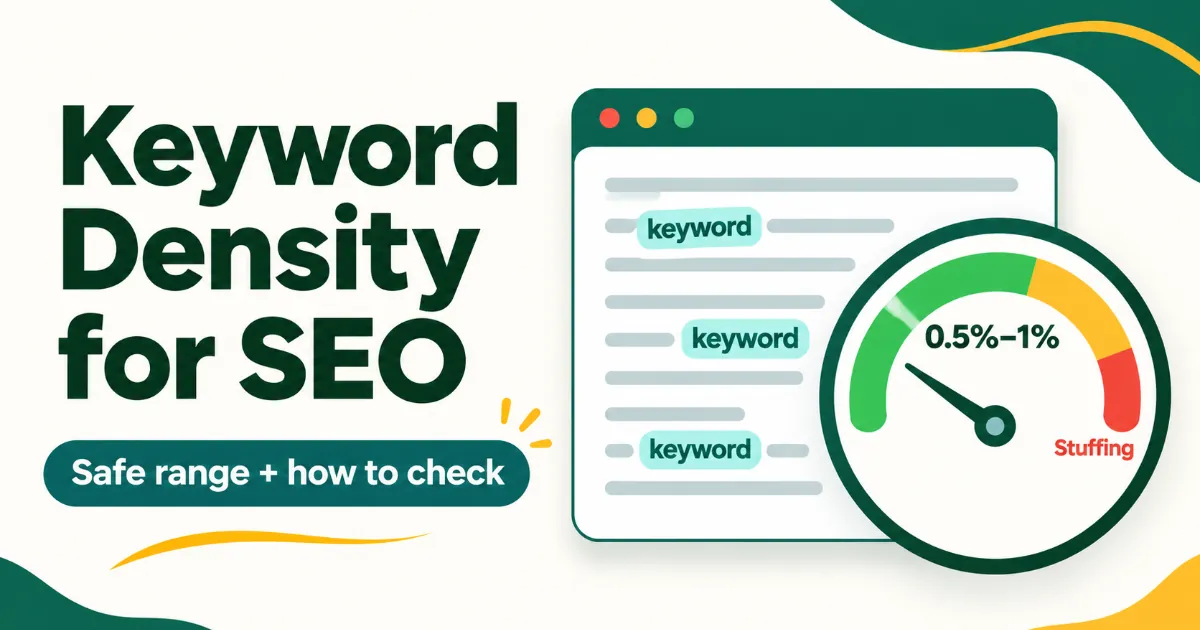
In uses per article, that means:
- 800 words: about 4 to 8 uses
- 1,500 words: about 8 to 15 uses
- 2,500 words: about 12 to 25 uses
If you land at 0.3% and every important spot already has the keyword, that's fine. If you're at 1.2% and it reads smoothly, that's also fine. Treat the range as a check on your writing.
Where the keyword should appear (this beats the count)
Ten well-placed uses do more than twenty scattered ones. Put the exact phrase in these spots first:
- SEO title, near the front.
- H1 (your post title).
- URL slug.
- First 100 words, ideally the opening sentence.
- Meta description.
- At least one H2, where it fits the question that section answers.
- One image's alt text, only if it describes that image. Our guide on how to name images for SEO covers file names and alt text.
After that, cover the topic properly. Related terms, questions people ask and the entities around your subject (tools, places, brands, methods) help Google understand the page far more than one more repetition. A content brief is the easiest way to collect those terms before you write.
How to check keyword density for SEO: 4 ways
1. By hand with Ctrl+F
Paste your draft into any editor, press Ctrl+F (Cmd+F on a Mac) and search the exact phrase. Note the match count, get the word count, and use the formula above. It takes a minute and it works anywhere.
2. In Google Docs
Ctrl+F shows the number of matches in the top-right of the search box. For the total, open Tools, then Word count (Ctrl+Shift+C). Divide, multiply by 100, done.
3. In Rank Math or Yoast
Set your focus keyword in the plugin box under the WordPress editor. The density check shows up in the SEO analysis as you write. Remember the two plugins use different ranges and count variations differently.
4. In SerpNuts
The SerpNuts content optimizer runs density checks on your focus keyword and up to five secondary keywords, along with 40+ other on-page checks based on Rank Math, Yoast and AIOSEO rules. It keeps each keyword at or under 1% and shows which terms and questions you still haven't covered. The free plan includes 10 optimizations a month.
Signs your article is keyword stuffed
You rarely need a tool to spot stuffing. Read the draft out loud and watch for these:
- The same phrase in back-to-back sentences, or twice in one sentence.
- Grammar bent to fit the keyword, like "best dentist Karnal near me is our clinic".
- Long lists of city or area names with no real information about each one. Google's spam policy names this pattern directly.
- Headings that are just the keyword with a word changed.
- Hidden or tiny text repeating the phrase. That's a spam violation regardless of density.
How to fix an over-optimised article
Here's a stuffed paragraph of the kind many local service pages still carry:
Looking for AC repair in Karnal? Our AC repair in Karnal service is the best AC repair in Karnal. Call now for AC repair in Karnal at low prices.
And a fixed version:
Need your AC repaired in Karnal? We service split and window units across the city, usually on the same day. Call us for a quote before we visit.
The keyword went from four uses to one, and the paragraph now tells the reader something. To fix a whole article:
- Find every use of the keyword with Ctrl+F.
- Keep it in the title, H1, first paragraph, slug, meta description and one H2.
- Replace the rest with a pronoun, a shorter reference ("the service", "this method") or a natural variation.
- Delete sentences that only exist to repeat the keyword.
- Add something useful where you cut: a real example, a price range you can stand behind, a step, a common question.
- Read it aloud once more, then recheck the density.
Hitting a high on-page score without stuffing is doable. Our guide to a 100/100 Rank Math score walks through it.
Does keyword density matter for AI Overviews and ChatGPT?
There's no evidence that AI answers count keyword repetitions. Google says optimizing for its AI features is the same as regular SEO. What helps a page get quoted is clarity: a direct answer near the top, specific facts, clear headings phrased like the questions people ask, and sections that make sense on their own. A stuffed paragraph is the opposite of what an AI system wants to quote.
Keyword density for SEO in Hindi and Hinglish content
Density tools match exact strings, so "होम लोन" and "home loan" count as different keywords. Pick the version your readers actually type into Google and use it as the focus keyword. Count the other script as a variation. For mixed Hinglish pages, keep the focus phrase in one consistent spelling, because "kaise kare" and "kaise karein" are separate matches to a plugin. Our Hindi blog SEO guide covers this in more depth.
FAQ
Is 2% keyword density bad?
Not automatically. Yoast still shows green at 2%, while Rank Math is close to its warning level. Read the page aloud. If the keyword sounds repetitive, cut it back toward 1%.
How many times should a keyword appear in 1,000 words?
Around 5 to 10 times for the exact phrase, with variations on top. Make sure the title, H1, first paragraph and one H2 are covered first.
Should I count keyword variations?
Count them for your own judgment, since readers notice them as repetition too. Plugins differ: Rank Math counts plurals and variations, while free Yoast matches only the exact keyphrase words.
Do stop words like "in" and "for" count?
Most tools include every word in the total count, stop words too. Within the keyword, they're matched as written, so "seo for blogs" and "seo blogs" are different phrases.
Can low keyword density hurt rankings?
Only if it means the topic is unclear. A page that never states its main phrase in the title, H1 or opening paragraph makes Google's job harder. Fix the placement and the density usually sorts itself out.
Check your keyword density for SEO in two minutes
Paste your next draft into the SerpNuts optimizer with your focus keyword. You'll see the density, where the keyword is missing and which related terms the top-ranking pages cover that you don't.