
Table of contents
Quick answer: Topical authority in SEO is how clearly your site shows that it knows one subject well, through a set of connected pages that answer the questions people ask about it. Google publishes no number for it. Its guidance rewards helpful, reliable content, and a site that covers a subject thoroughly is easier to trust than one that touches it once.
If you're asking what is topical authority in SEO, you've probably noticed that some small blogs outrank big sites on narrow subjects. Usually they cover that one subject from every useful angle. They also link those pages together, so readers and Google can follow the trail.
Below you'll find a plain definition, what Google has actually said about it, how it differs from domain authority, and a step-by-step way to build it with a pillar page and topic clusters.
What is topical authority in SEO?
Topical authority is the depth and consistency of your coverage on one subject. Picture a site about home loans that explains eligibility, documents, EMI calculation, prepayment and tax benefits, and links those pages together. It has more of it than a site with one generic "home loan guide" and fifty posts on unrelated topics.
You won't find it as a number in any tool. Think of it as how complete and trustworthy your coverage looks to a reader who lands on any one page and wants the next answer.
What has Google actually said about it?
Google uses the phrase in one specific place. In May 2023 Google explained a topic authority system for news, which helps it surface expert sources for newsy queries in areas like health, finance or politics. The signals it named were how notable a source is for a topic or location, how much original reporting it does, and its reputation for quality.
For everyday blogs and business sites, the closest official guidance is Google's page on creating helpful, reliable, people-first content. Two lines from it matter here. Google says E-E-A-T (experience, expertise, authoritativeness and trust) "itself isn't a specific ranking factor", and it lists "producing lots of content on many different topics" as a warning sign of search engine-first content. Put together: depth on a subject you genuinely know is the safe bet, and spreading thin is the risky one.
Topical authority vs domain authority
Domain authority is a third-party score, created by Moz, that estimates a whole domain's strength mostly from backlinks. Google doesn't use it. Topical authority is about subject coverage instead, so a young site can build it on a narrow subject long before it has many links.
| Point | Topical authority | Domain authority |
| What it describes | Depth of coverage on one subject | Overall link strength of a domain |
| Who defines it | An SEO concept, no official score | Moz (similar scores exist from Ahrefs and Semrush) |
| Used by Google? | Google rewards helpful coverage, but publishes no such score | No, it's a third-party metric |
| How you grow it | Answer every important question on your subject and link the pages | Earn links from other sites |
The practical takeaway: you can't do much about domain authority this week, but you can plan and publish the next five pages on your main subject.
Topic clusters and the pillar page
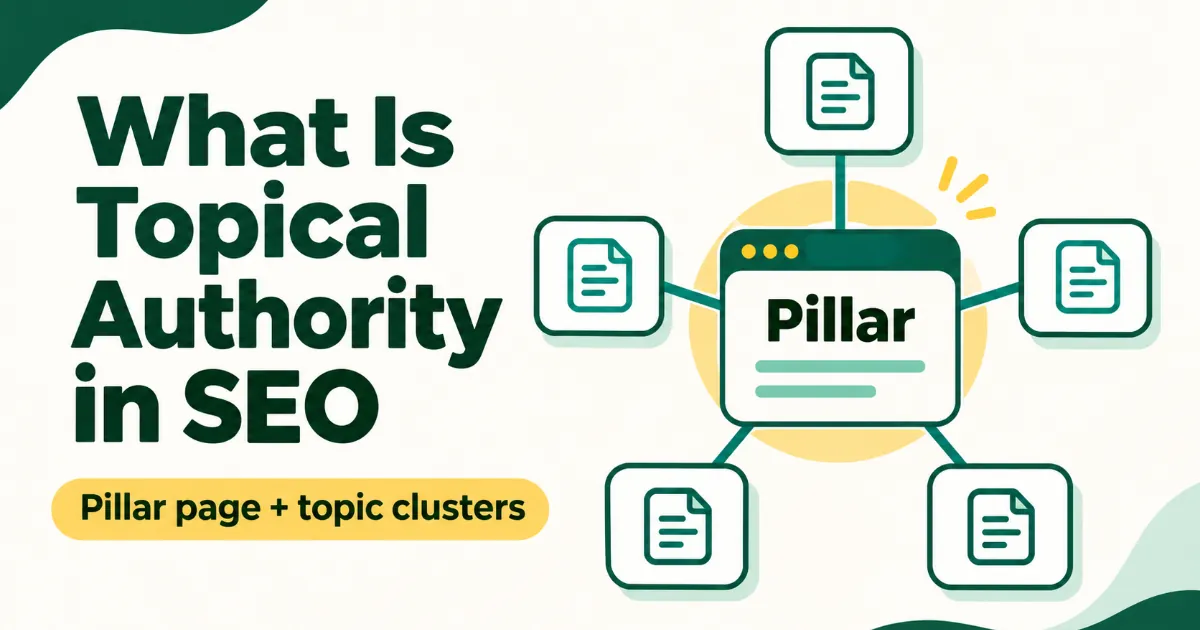
A topic cluster is a group of pages on one subject. The pillar page covers the broad topic and links out to supporting articles, and each supporting article answers one narrower question and links back to the pillar.
Take a site about mutual funds. The pillar could be "Mutual funds for beginners". Supporting articles might cover SIP vs lump sum, how to read an expense ratio, direct vs regular plans, and how mutual funds are taxed. Every supporting page links to the pillar with descriptive anchor text. It also links to its closest sibling where a reader would naturally want it.
Google's link best practices back this up in plain terms: every important page should be linked from at least one other page, and anchor text should be descriptive and relevant to both pages. A cluster simply makes that systematic.
How to build topical authority: 6 steps
Knowing what is topical authority in SEO helps only if you turn it into a plan. These six steps work for a blog, a service business or an online store.
- Pick one subject you can genuinely help with. Choose the area where you have real experience, products or results. Topical authority built on borrowed knowledge reads thin, and the "Who" and "How" in Google's guidance are hard to show.
- List the questions people ask. Type your main topic into Google and note the "People also ask" questions, related searches and the headings used by pages that rank. Group them into subtopics.
- Match each subtopic to search intent. Some questions need a how-to guide, some a comparison, some a product or service page. Our guide to search intent in SEO shows how to read that from the results page.
- Plan the pillar and the cluster before you write. Decide which page is the pillar, which pages support it, and which anchor text each link will use. A content brief template keeps every page focused on its own question.
- Publish the pillar first, then the supporting pages. Add the links as each page goes live, so no page sits alone without an internal link pointing to it.
- Review and fill gaps. Every few months, check Search Console for queries where you get impressions but no page answers them well, and add or update a page for each one.
Show real experience on every page
Coverage alone can look like a content farm. What makes it believable is evidence that a real person with real knowledge wrote it: an author name and short bio, your own screenshots or numbers, examples from your clients or your market, and a clear note on how the content was produced. That's the "Who, How and Why" Google asks site owners to think about.
How internal links support topical authority
Internal links are how a cluster becomes visible. Without them, ten good articles on one subject are ten separate pages. With them, a reader can move from the overview to the detail they need, and Google can see how the pages relate.
Keep the anchor text honest. "How mutual funds are taxed" tells both readers and Google what the next page covers, while "click here" tells them nothing. Don't force links into every paragraph. A few links where a reader wants the next step do more than a dozen that interrupt.
Mistakes that weaken topical authority
- Publishing on many unrelated subjects to chase traffic, which Google's own guidance lists as a warning sign.
- Writing several thin pages that answer the same question in slightly different words.
- Leaving supporting articles without a link to or from the pillar page.
- Covering a subject you have no experience in, with nothing original to add.
- Repeating the main keyword instead of answering the next question; see our note on keyword density for SEO.
FAQ
What is topical authority in SEO, in one line?
It's how completely and reliably your site covers one subject, shown through connected pages that answer the questions people ask about it.
Is topical authority a Google ranking factor?
Google doesn't list a general "topical authority" factor. It has described a topic authority system for news results, and its guidance rewards helpful, reliable content. Deep, well-linked coverage of a subject is the way to show that.
How long does it take to build topical authority?
There's no fixed timeline. It depends on how competitive your subject is, how many important questions you still haven't answered and how good each page is. Track impressions for your topic in Search Console to see the trend on your own site.
Can a small website build topical authority?
Yes. A narrow subject is easier to cover completely, so a small site that answers every important question on one niche can compete with larger sites that cover it once.
How many articles do I need in a topic cluster?
As many as it takes to answer the questions people actually ask about that subject, and no more. Start from your list of questions rather than a target number.
How does E-E-A-T relate to topical authority?
E-E-A-T describes what makes content trustworthy: experience, expertise, authoritativeness and trust. Topical authority is one way those qualities show up across a site, when many connected pages reflect the same real knowledge.
Plan your first topic cluster
Pick one subject, write down the questions your readers ask, and decide which page is the pillar before you write anything new. If you'd like help with the map, the SerpNuts Content Cluster planner builds a pillar page, supporting articles and an internal-linking map with anchor text for a topic, and the free plan includes 10 content optimizations a month.